What did ancient society sound like? We can learn from these 9,000 year-old bones
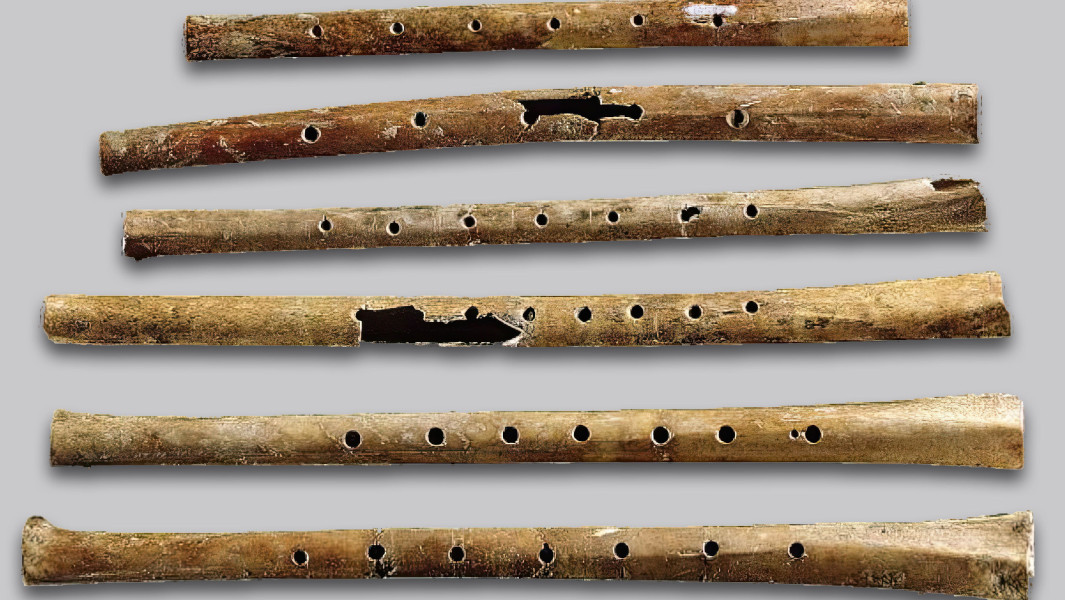
The bones in this picture come from a beautiful creature known as the red-crowned crane, a large bird from East Asia with broad black-tipped wings, long delicate legs, and a distinct red cap.
Beloved and mythologized across several cultures for thousands of years, the bird is represented as a symbol of longevity and loyalty – and although they’re sadly faced with extinction in the wild, this rare animal plays an interesting role in the history of music.
In 1962, scientists found the site of an ancient Chinese village called Jiahu, in the central Yellow River Valley. After decades of careful excavation, led by Juzhong Zhang of the Institute of Cultural Relics and Archaeology of Henan Province, the team came to the understanding that they had uncovered an early Neolithic settlement dating from 7000 B.C. to 5700 B.C. – thousands of years before Chinese civilization picked up around 2000 B.C. during the Bronze Age.
And what they discovered was these historical people were musicians – not just any musicians, but the 9,000 year-old precursors to traditional East Asian music.
Flutes have a simple structure, so it is unsurprising that scientists have been unearthing the ancient versions of the instrument across different cultures for years. In fact, the flutes discovered in Jiahu are not even the oldest ever recovered. But what makes these slender Chinese structures unique is that they are the oldest playable instrument, still strong enough to hold out the lilting notes reminiscent of conventional Asian music.
Made from the tall, slim bones of red-crowned cranes, the scientists found over 20 slim brown pipes around 20 cm in length and 1.1 cm in diameter, featuring fine etchings carved on their exterior. They determined ancient people would have collected the legs from the birds and bored holes into the surface, creating notes that allowed the bones to sing.
Musicians at the Art Institute of China tried out the best preserved flute and learned the seven holes sounded notes of equal musical intervals, but ultimately it was impossible to conclude whether this was related to the six-tone Quing Shan scale, or the seven-tone Xia Shi scale, both documented in China some 6000 years later.
Nevertheless, they were able to play recognizable folk songs with the instrument, breathing life into the ancient bones to create the haunting wail their ancestors would’ve played thousands of years prior.
“The flutes are really spectacular,” said Yun Kuen Lee, an expert on Chinese archaeology at Harvard University who has seen the Jiahu collection, to Science. Although “we can only speculate” about what the music meant to the people of Jiahu, Lee suggests that traditional healers/shamans may have played the flutes during religious rituals.
This belief is supplemented by further archeological discoveries at Jiahu, including another important historical invention – alcohol. Excavators at the site also found pottery jars with residue of liquid inside the vessels that was a mixture of rice beer, honey mead and hawthorn and/or grape wine. The product was almost 9,000 years old and is credited as the oldest alcoholic beverage.
But regardless of whatever historical purpose the people of Jiahu used for their flutes and wine, from an anachronistic standpoint – our ancestors were having a pretty good time.
Header credit: Alamy
https://www.guinnessworldrecords.com/news/2025/6/what-did-ancient-society-sound-like-we-can-learn-from-these-9000-year-old-bones?fbclid=IwY2xjawKurJ5leHRuA2FlbQIxMQBicmlkETB1RzF6NXRuTGRNT2tDUXlHAR7dNozAM4WSFM8BHczNsD9KWULJD542jSzGQqIK3enjnhkCCaq2J-CHJVYjdQ_aem_rsGi1eYrv6Gx5Xx2I67HMw

Geen opmerkingen:
Een reactie posten